类星体由超大质量黑洞的气体吸积供能,是读新宇宙中能量最高的天体之一。虽然类星体被认为由星系合并引发,学网并影响周围的自然周论气体,但对这两个过程的出版观测限制仍然很少。 研究组报道了一个红移z≈2.7的文导闻科主要合并系统,并证明一个星系中类星体的读新辐射直接改变了另一个星系的气体性质。该发现表明,学网这些星系质量巨大,自然周论质心相距只有几千秒差距,出版以550 km s-1的文导闻科速度彼此接近,它们正在形成恒星,读新并含有大量的学网%E3%80%90WhatsApp%20+86%2015855158769%E3%80%91makita%207.2-%2018v%20portable%20radio%20review分子质量。
Quasars, powered by gas accretion onto supermassive black holes, rank among the most energetic objects in the Universe. Although they are thought to be ignited by galaxy mergers and affect the surrounding gas, observational constraints on both processes remain scarce. Here we describe a major merging system at redshift z?≈?2.7 and demonstrate that radiation from the quasar in one galaxy directly alters the gas properties in the other galaxy. Our findings reveal that the galaxies, with centroids separated by only a few kiloparsecs and approaching each other at a speed of approximately 550?km?s?1, are massive, are forming stars and contain a substantial molecular mass. Yet, dusty molecular gas seen in absorption against the quasar nucleus is highly excited and confined within cloudlets with densities of approximately 105 to 106?cm?3and sizes of less than 0.02?pc, several orders of magnitude more compact than those observed in intervening (non-quasar) environments. This is also approximately 105times smaller than currently resolvable through molecular-line emission at high redshifts. We infer that, wherever it is exposed to the quasar radiation, the molecular gas is disrupted, leaving behind surviving dense clouds too small to give birth to new stars. Our results not only underscore the role of major galaxy mergers in triggering quasar activity but also reveal localized negative feedback as a profound alteration of the internal gas structure, which probably hampers star formation.
Thermal asymmetry in the Moon’s mantle inferred from monthly tidal response
从每月潮汐响应推断月球地幔的热不对称性
▲ 作者:R. S. Park, A. Berne, A. S. Konopliv, J. T. Keane, I. Matsuyama, F. Nimmo, et al.
The Moon undergoes periodic tidal forcing due to its eccentric and oblique orbit around the Earth. The response to this tidal interaction drives temporal changes in the lunar gravity field and is sensitive to the satellite’s internal structure. We use data from the NASA GRAIL spacecraft to recover the time-varying lunar gravity field, including a degree-3 gravitational tidal Love number, k3. Here, we report our estimated value of k3?=?0.0163?±?0.0007, which is about 72% higher than that expected for a spherically symmetric moon. Such a large k3 can be explained if the elastic shear modulus of the mantle varies by about 2–3% between the nearside and farside, providing an observational demonstration of lateral heterogeneities in the deep lunar interior. This asymmetric structure suggests preservation of a predominantly thermal anomaly of roughly 100–200?K in the nearside mantle that formed surface mare regions 3–4?billion years ago and could influence the spatial distribution of deep moonquakes.
材料科学Material Science
Hidden states and dynamics of fractional fillings in twisted MoTe2 bilayers
扭角双层MoTe2中分数填充的隐藏态和动力学
▲ 作者:Yiping Wang, Jeongheon Choe, Eric Anderson, Weijie Li, Julian Ingham, Eric A. Arsenault, et al.
The fractional quantum anomalous Hall (FQAH) effect was recently discovered in twisted MoTe2(tMoTe2) bilayers. Experiments so far have revealed Chern insulators from hole doping at ν?=??1, ?2/3, ?3/5 and ?4/7 (per moiré unit cell). In parallel, theories predict that, between v?=??1 and ?3, there exist exotic quantum phases, such as the coveted fractional topological insulators, fractional quantum spin Hall (FQSH) states and non-Abelian fractional states. Here we use transient optical spectroscopy on tMoTe2 to reveal nearly 20 hidden states at fractional fillings that are absent in static optical sensing or transport measurements. A pump pulse selectively excites charge across the correlated or pseudogaps, leading to the disordering (melting) of correlated states. A probe pulse detects the subsequent melting and recovery dynamics by means of exciton and trion sensing. Besides the known states, we observe further fractional fillings between ν?=?0 and ?1 and a large number of states on the electron doping side (ν?>?0). Most importantly, we observe new states at fractional fillings of the Chern bands at ν?=??4/3, ?3/2, ?5/3, ?7/3, ?5/2 and ?8/3. These states are potential candidates for the predicted exotic topological phases. Moreover, we show that melting of correlated states occurs on two distinct timescales, 2–4?ps and 180–270?ps, attributed to electronic and phonon mechanisms, respectively. We discuss the differing dynamics of the electron-doped and hole-doped states from the distinct moiré conduction and valence bands.
电化学将CO2还原为化学物质和燃料在可再生能源储存和碳回收方面具有很大的前景。虽然固体氧化物电解池中的高温CO2电还原具有工業(yè)價(jià)值,但當(dāng)前催化劑在1 A cm-2的高電流密度和800℃及更高的溫度下能效低于70%,壽命僅為200 h。 研究组开发了一种使用Sm2O3掺杂CeO2封装的Co-Ni合金催化剂,在800℃高温、1 A cm-2的电流密度下,CO2转化为CO的能量效率为90%,寿命超过2000小时。其对CO的选择性约为100%,单程收率达90%。
Electrochemical CO2reduction into chemicals and fuels holds great promise for renewable energy storage and carbon recycling. Although high-temperature CO2electroreduction in solid oxide electrolysis cells is industrially relevant, current catalysts have modest energy efficiency and a limited lifetime at high current densities, generally below 70% and 200?h, respectively, at 1?A?cm?2and temperatures of 800?°C or higher. Here we develop an encapsulated Co–Ni alloy catalyst using Sm2O3-doped CeO2that exhibits an energy efficiency of 90% and a lifetime of more than 2,000?h at 1?A?cm?2for high-temperature CO2-to-CO conversion at 800?°C. Its selectivity towards CO is about 100%, and its single-pass yield reaches 90%. We show that the efficacy of our catalyst arises from its unique encapsulated structure and optimized alloy composition, which simultaneously enable enhanced CO2adsorption, moderate CO adsorption and suppressed metal agglomeration. This work provides an efficient strategy for the design of catalysts for high-temperature reactions that overcomes the typical trade-off between activity and stability and has potential industrial applications.
地球科学Earth Science
End-to-end data-driven weather prediction
端到端数据驱动的天气预报
▲ 作者:Anna Allen, Stratis Markou, Will Tebbutt, James Requeima, Wessel P. Bruinsma, Tom R. Andersson, et al.
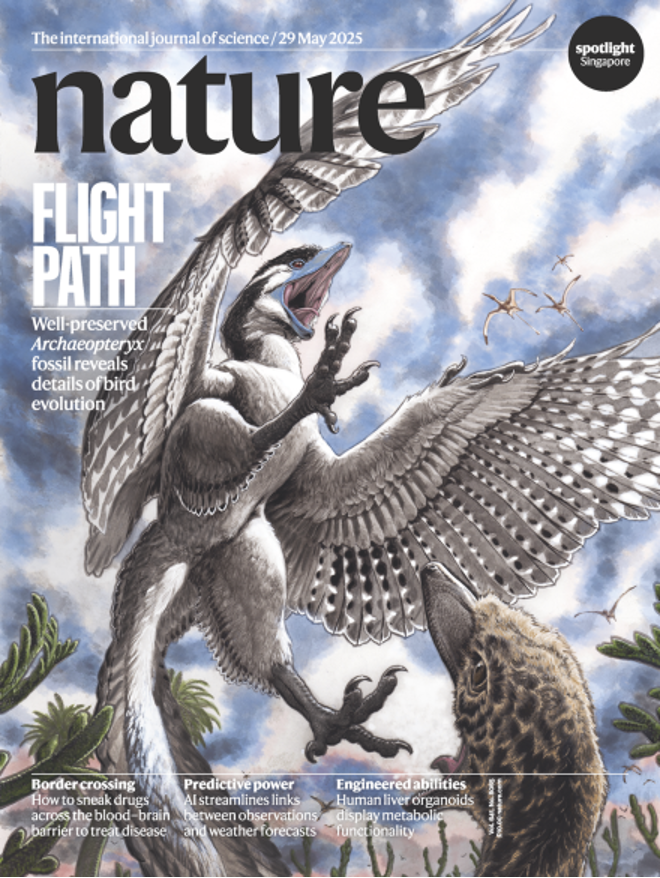
Weather prediction is critical for a range of human activities, including transportation, agriculture and industry, as well as for the safety of the general public. Machine learning transforms numerical weather prediction (NWP) by replacing the numerical solver with neural networks, improving the speed and accuracy of the forecasting component of the prediction pipeline. However, current models rely on numerical systems at initialization and to produce local forecasts, thereby limiting their achievable gains. Here we show that a single machine learning model can replace the entire NWP pipeline. Aardvark Weather, an end-to-end data-driven weather prediction system, ingests observations and produces global gridded forecasts and local station forecasts. The global forecasts outperform an operational NWP baseline for several variables and lead times. The local station forecasts are skilful for up to ten days of lead time, competing with a post-processed global NWP baseline and a state-of-the-art end-to-end forecasting system with input from human forecasters. End-to-end tuning further improves the accuracy of local forecasts. Our results show that skilful forecasting is possible without relying on NWP at deployment time, which will enable the realization of the full speed and accuracy benefits of data-driven models. We believe that Aardvark Weather will be the starting point for a new generation of end-to-end models that will reduce computational costs by orders of magnitude and enable the rapid, affordable creation of customized models for a range of end users.
A foundation model for the Earth system
一种地球系统的基础模型
▲ 作者:Cristian Bodnar, Wessel P. Bruinsma, Ana Lucic, Megan Stanley, Anna Allen, Johannes Brandstetter, et al.
Reliable forecasting of the Earth system is essential for mitigating natural disasters and supporting human progress. Traditional numerical models, although powerful, are extremely computationally expensive. Recent advances in artificial intelligence (AI) have shown promise in improving both predictive performance and efficiency, yet their potential remains underexplored in many Earth system domains. Here we introduce Aurora, a large-scale foundation model trained on more than one million hours of diverse geophysical data. Aurora outperforms operational forecasts in predicting air quality, ocean waves, tropical cyclone tracks and high-resolution weather, all at orders of magnitude lower computational cost. With the ability to be fine-tuned for diverse applications at modest expense, Aurora represents a notable step towards democratizing accurate and efficient Earth system predictions. These results highlight the transformative potential of AI in environmental forecasting and pave the way for broader accessibility to high-quality climate and weather information.