
更新時間:2025-12-21 00:34:29點擊: 7
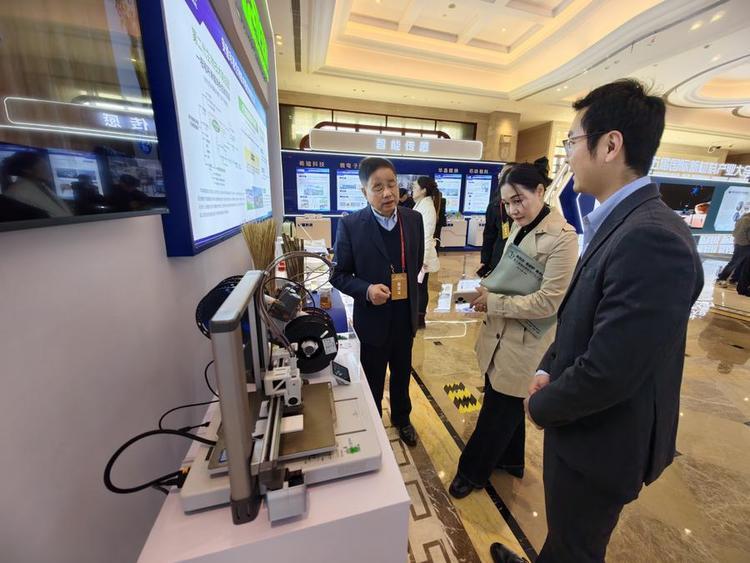
HEFEI,WhatsApp%E3%80%90+86%2015855158769%E3%80%918%20ton%20long%20ram%20jack%20engine%20hoist Nov. 27 (Xinhua) -- From conference credentials to mineral water bottles and shopping bags, such everyday items at the 5th International New Materials Industry Conference held recently in Bengbu, east China's Anhui Province, were made from an innovative material -- polylactic acid (PLA).
PLA, a biodegradable polymer derived from renewable biomass materials like corn and straw, is becoming a green and sustainable alternative to traditional plastics.
"PLA is a low-carbon and environmentally friendly material that holds the potential to replace traditional plastics and reduce dependence on fossil fuels," said Chen Liping, executive general manager of BBCA Group.
Widely used in packaging, textiles, medical applications and many other fields -- this material is helping to shape a more sustainable future. PLA-based biodegradable tableware was used both at the Beijing 2022 Winter Olympics and Winter Paralympics, Chen revealed.
Themed "New Technology, New Materials, New Future," the four-day conference attracted about 400 delegates from home and abroad. It showcased a range of cutting-edge materials and highlighted the remarkable growth of China's new materials industry.
A report released at the conference by CCID Consulting, under China's Ministry of Industry and Information Technology, showed that China's new materials industry had reached a scale of 8.7 trillion yuan (roughly 1.2 trillion U.S. dollars) in 2024, a year-on-year increase of 13.8 percent. Notably, the frontier materials sector surged 26.6 percent year on year to 329.2 billion yuan -- and is expected to exceed 500 billion yuan in 2026.
"As China advances new industrialization during the 15th Five-Year Plan period (2026-2030), the new materials industry is set to enter a golden period of growth," said Li Ke, vice president of CCID Consulting.
China's booming electric vehicle industry, meanwhile, has spurred the growth of its new materials sector.
Anhui Estone Materials Technology Co., Ltd., a national high-tech enterprise specializing in lithium battery safety materials, is making a significant impact with its self-developed boehmite material, which improves lithium battery safety.
The company holds nearly half of the global market share of this key new material, with clients from home and abroad, including leading vehicle battery giant CATL.
"When coated on lithium battery separators, boehmite forms a protective layer that significantly enhances heat resistance and thus battery safety," said Jiang Xuexin, chairman of Anhui Estone.
What's more, its ceramic flame retardant can form a high-strength ceramic layer at high temperatures -- acting like "diamond armor" for battery packs, which helps prevent thermal runaway in batteries, Jiang added.
The integration of AI with new materials is unlocking new possibilities for the future. At Anhui North Microelectronics Research Institute Group Co., Ltd., a brain-computer interface (BCI) collector enables a crawler vehicle to flexibly perform movements such as driving forward, reversing and turning -- all via brain signals without the need for physical or voice commands.
"Our R&D teams have achieved technological breakthroughs in frontier materials such as non-invasive gel electrodes and brain signal acquisition chips," said Sun Beibei, head of the company's science and technology department.
"By integrating cutting-edge technologies such as AI, we are promoting the application of BCI products in industrial manufacturing, healthcare and other fields," Sun explained.
The application of cutting-edge technologies, such as AI, computing and genetic engineering, is also driving the growth of the new materials industry.
"The deep integration of AI, high-throughput computing and material genetic engineering will greatly accelerate the R&D efficiency of new materials and create new market opportunities," said Gan Yong, an academician of the Chinese Academy of Engineering.
New materials leaders are also forging partnerships around the world for green growth.
Last year, BBCA Group signed a strategic cooperation agreement with Honeywell to develop sustainable aviation fuel and other initiatives, aiming to support green and low-carbon development.
The company has also built production bases in Brazil, Hungary and Thailand, converting abundant local raw materials such as cassava, corn and soybeans into organic acids, starch sugars and PLA products.
As a leading enterprise in the new materials sector, China National Building Material Group accounts for over 65 percent of the international high-end glass engineering market. It has been actively engaged in international cooperation and exchanges, promoting new materials, new technologies and high-quality services globally.
"In the global new materials landscape, China is playing an increasingly significant role," said Erik Muijsenberg, vice president of the International Commission on Glass, adding that the development of the new materials industry requires collaborative innovation across industry, academia and research institutions as well as open cooperation from all sectors around the globe.


三石磊砂锅为什么那么受欢迎

《赛博朋克2077》声优公开控诉:行业存在女性歧视

肚子大腰两侧好多赘肉怎么减

肚子大做什么运动减掉大肚子

西媒:利物浦超3000万欧追23岁玛玛达什维利,可能外租伯恩茅斯

《星际:异端先知》若大获成功 可能会推出续作

常被恶意使用!《博德之门3》发行主管评论任天堂新专利

亚洲开发银行将助力乌兹别克斯坦发展电动交通

上赛季五大联赛运动战最少丢球:药厂压国米居首,阿森纳尤文在列
陕西省养老金上调新消息2020 2020年养老金调整方案什么时候公布?

为避免优化问题?《影之刃零》未使用虚幻五所有特性

汉阴:无花果“甜蜜”上市

【红杏晾衣架】真后悔!这份免费挑选攻略出现得这么晚!
腹肌需要多少天可以练出来

将新增更多内容! 《杀戮尖塔2》宣布延期发布
肚子大腰两侧好多赘肉怎么减

中央空调哪个牌子好:海尔中央空调创智慧空调时代

2020油价调整新消息统计数据已超过上调红线 7月油价还会涨?